YOps
YOps is the mutation language of T3X. It is a small YAML operation list that says exactly how structured state should change.
The LLM can write a draft. The user can edit it. The engine applies it.
raw source -> proposed YOps -> deterministic apply -> materialized tree
Use The Package
The current npm package version is @t3x-dev/yops@0.4.1, and it is part of the
current alpha package surface. Package availability follows
Release Status, and npm may return 404 for accounts without
restricted alpha access.
YOps is distributed as an npm package. A missing matching GitHub runtime release
entry does not mean the YOps package is unpublished; GitHub runtime assets are
only expected for @t3x-dev/local.
Install it when you want the deterministic YAML operation engine inside your own app and your npm account has restricted alpha access:
npm install @t3x-dev/yops
If npm cannot resolve the package, use the source workspace until package access is granted.
If npm cannot resolve the package, use the source workspace until package access is granted.
If npm cannot resolve the package, use the source workspace until package access is granted.
YOps does not require a model provider key. It is deterministic code: YAML-like document in, operation list in, updated document out.
import { applyYOps } from '@t3x-dev/yops';

const doc = {
  config: {
    host: 'old.example.com',
  },
};

const result = applyYOps(doc, [
  { set: { path: 'config/host', value: 'app.example.com' } },
  { set: { path: 'config/port', value: 5432 } },
  { define: { path: 'config/features' } },
  {
    populate: {
      path: 'config/features',
      values: { auth: true, logging: true },
    },
  },
]);

if (result.ok) {
  console.log(result.doc);
}
The package also exports helpers such as validateOps, parseYOpsYaml,
formatYOps, and classifyYOp for validation, YAML parsing/formatting, and
operation-family classification.
A Small Story
Imagine a support lead is preparing a Friday pilot for a customer support assistant. The team recently found that refund replies were too casual: the assistant sometimes skipped the order id, forgot to cite policy, or sounded like it had already approved a refund before manual review.
The lead does not want this rule to live only in a chat transcript or a loose prompt. She wants it to become reviewable project state, so she pastes this source note into T3X:
Refunds above $100 require manual review. Replies must ask for order id,
cite policy, and name the refund amount before deciding. Tone should be calm,
precise, and policy-grounded. Do not invent policy details or guarantee outcomes.
T3X does not immediately turn that note into a hidden database update. It keeps the original note visible and proposes a YOps mutation. The proposal turns one paragraph into named, reviewable facts:
yops:
  - define:
      path: support_escalation_review
  - populate:
      path: support_escalation_review
      values:
        objective: tighten refund escalation behavior for a customer support assistant
        audience: customer support team
        owner: support operations
        source: support lead pilot note
        status: draft
        rollout: pilot on Friday
  - define:
      path: support_escalation_review/refund_policy
  - populate:
      path: support_escalation_review/refund_policy
      values:
        threshold: Refunds above $100 require manual review
        decision_state: review before deciding
        required_evidence:
          - order id
          - policy citation
          - refund amount
        forbidden_behavior: do not invent policy details
  - define:
      path: support_escalation_review/tone_and_safety
  - populate:
      path: support_escalation_review/tone_and_safety
      values:
        tone:
          - calm
          - precise
          - policy-grounded
        avoid:
          - guaranteeing outcomes
Before applying it, the user can inspect the YAML like a small change request:
- Is the refund threshold captured exactly?
- Are required evidence items separated from tone guidance?
- Is the rollout scope still a Friday pilot, not a permanent policy?
- Did the extraction invent anything that was not in the source note?
If something is wrong, the user can edit the YOps, ask for a revised proposal, or discard it. Nothing becomes project state until Apply runs the deterministic engine.
After Apply, the tree has explicit nodes for the pilot, refund policy, and tone rules. Commit records the source note, the reviewed YOps, and the resulting state tree together. A later policy change is no longer prompt archaeology; it becomes a diff against a named, auditable part of the project.
What Happens In The WebUI
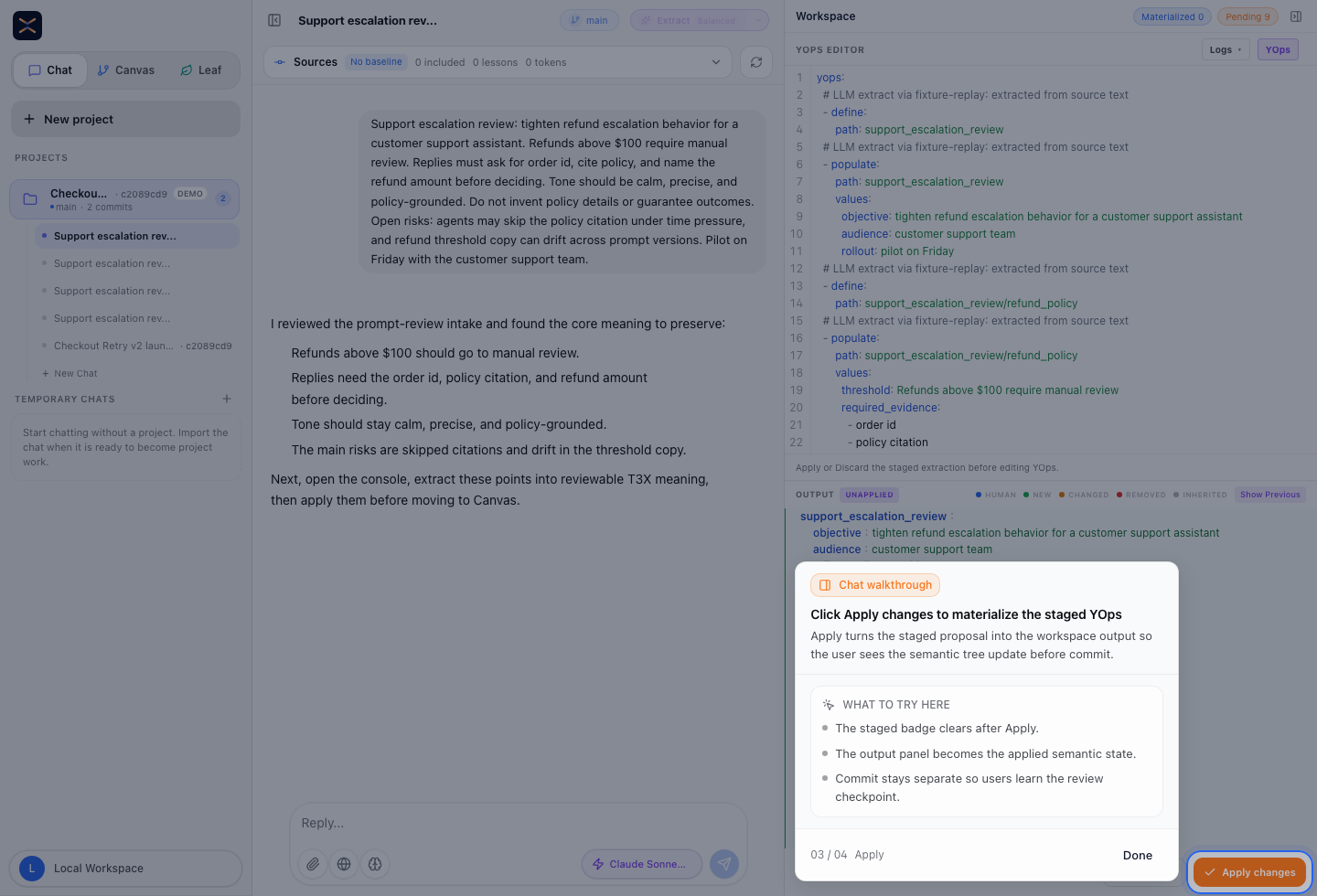
- Chat stays lightweight. The reply is still conversation.
- Workspace opens the YOps editor and output panel.
- Extract produces a staged YOps proposal. It is marked pending/unapplied.
- Apply runs the deterministic engine. The output tree becomes materialized.
- Commit saves the reviewed structured state.
Why YAML
YAML is useful here because it is:
- Reviewable: people can inspect it before applying.
- Editable: agents and humans can patch it without inventing a second protocol.
- Replayable: the same operations applied to the same input produce the same output.
- Auditable: the operation log explains how a commit's tree was built.
The Rule
All tree mutation goes through YOps.
That includes WebUI edits, CLI edits, MCP edits, extraction repair, inline source edits, and generated fixes. If a feature needs to change structured state, it should emit YOps and let the engine validate/apply them.
Operation Families
| Family | Job | Examples |
|---|---|---|
| DDL | Create, remove, rename structure | define, drop, rename |
| DML | Fill or edit values | set, unset, populate, append |
| DTL | Reshape existing structure | move, clone, nest, split, fold, merge, sort, unique, pick, omit |
| DCL | Check without changing | assert |
See Operation Board for one example per operation.
Runtime Source Of Truth
The canonical operation contract is
packages/yops/yops.yaml
in the core repo. It defines:
- operation fields
- validation rules
- error codes
- conformance test cases
The TypeScript package is the reference implementation, but the spec is written so another language can implement a compatible engine.
Alpha Contract
YOps is part of the current alpha surface. During this phase, the contract-bearing surface includes:
- operation names
- operation families (
ddl,dml,dtl,dcl) - required and optional fields
- field types and enum values
- path syntax and path matching behavior
- engine runtime error codes
- validator diagnostic codes and severity
- conformance cases in
yops.yaml - recipes and examples that users or agents may copy
Additive or non-breaking changes preserve existing valid input and behavior. For example, T3X may add an optional field, add an enum value, add a new operation, add a new runtime error for a new failure mode, add a validator diagnostic code, or add conformance cases that document existing behavior.
Breaking changes alter the contract users or tools can rely on. Examples include removing or renaming an operation, moving an operation to another observable family, removing or renaming a field, changing path parsing, changing operation ordering or fail-fast behavior, removing an error or diagnostic code, escalating a diagnostic from advisory to blocking, or changing examples in a way that invalidates previously documented behavior.
See Stability Policy for the full release rule, including the review and conformance gate for future YOps tightening work.